Söldnerklan Feuerschwarz
Tinea and Leah: [Cyberpunk, Alien Incursions, Murder and Mayhem, Girl's Love (WLW)]Söldnerklan Feuerschwarz is a mercenary clan headquartered in a concealed underground complex within the suburban district of Nürnbergs Mähre, Megacity Nuremberg, Bavaria, Germany. Known as a “fire blackened” organization, it has survived for decades by combining secrecy, coercive discipline, and commercial violence. Its defining significance is not merely that it fights: it manufactures soldiers through abuse, protects its own power through elaborate security, and treats the kidnapping of newly created samurai as a market opportunity.
Identity and Headquarters
Söldnerklan Feuerschwarz operates from an undisclosed location at the edge of the Deadzone, in territory where the Antithesis rules. The clan's headquarters is a circular collection of underground caverns that has preserved its secrecy and anonymity for thirty years. The subterranean layout does more than conceal the organization from outsiders; it also prevents lost children from being found and rescued after they have been subjected to the clan's conditioning and training.
The clan leader's office reflects the same paranoia and engineering-minded defensiveness. It is a small fortress with only one entrance, positioned around a bend designed to redirect a laser back toward its source regardless of the angle. Grenades thrown with enough force to reach the office are likewise turned away before they can enter. The headquarters therefore embodies the clan's governing principle: every approach must be anticipated, redirected, and made dangerous to the intruder.
Command and Internal Power
Söldnerklan Feuerschwarz is ruled by Hengst Rheinschiffer, who has led the clan for forty years and has been its head for four decades despite being sixty years old. His authority rests less on formal legitimacy than on psychological manipulation. He understands the human mind with the skill of a sadistic surgeon, turning the clan's collective hatred and ambition into instruments of his own will. His decisions bleed his soldiers and torture their already damaged souls, driving their rage toward increasingly ambitious violence while keeping the consequences directed away from himself.
Hengst has established his kingdom at the boundary of Antithesis territory without allowing the Antithesis to focus its attention on his members. The achievement is presented as a form of administrative skill, but its foundation is predatory: his power is secured through the suffering of soldiers and victims alike. His office's defenses, his manipulation of subordinates, and his pleasure in petty power games all express the same structure of control.
Kain, Hengst Rheinschiffer's Second, illustrates how that control operates at close range. When Hengst leads him from the office, Kain feels the leader's breath across his neck and has to suppress the bodily signs of prey. Hengst deliberately changes direction without explanation, forcing Kain to turn around and catch up. The act has no strategic value; its purpose is to impose a degrading pattern and remind Kain that even movement through the headquarters occurs on Hengst's terms. Kain keeps quiet and pretends that everything is fine, while Hengst privately enjoys the submission he has produced.
Recruitment and Conditioning
The clan's caverns contain groups of boys at different stages of training. Their education is organized around pain, screaming, harassment, beatings, and worse violations when they fail to suppress their reactions. The children are not being broken down and rebuilt as disciplined soldiers in any rehabilitative or protective sense. They are being broken down and turned into vengeful, sadistic animals.
The process is tied to the clan's Soldatenweihe, or soldier's ordination. In one hall, young men approaching the final stage of conditioning are expected to complete that process in six months. Hengst anticipates that the survivors will become his thugs, with a rare few elevated into operatives. The distinction shows how the clan extracts different kinds of value from the same system: most trainees become expendable instruments of force, while a select minority receive greater responsibility within the organization.
One cavern sharply contrasts with the training halls. The path through it is divided by razor-wire-tipped fences, yet the space beyond contains softly lit, genuinely comfortable underground houses. No male resident has a gate or access point into it, not even Hengst himself. The arrangement suggests a protected female enclave within the clan's otherwise brutal institution, but the evidence emphasizes its separation rather than explaining its residents or internal life. Its existence makes the headquarters more than a barracks: it is a controlled social world whose spaces are allocated according to power, gender, and exclusion.
Operations and Opportunism
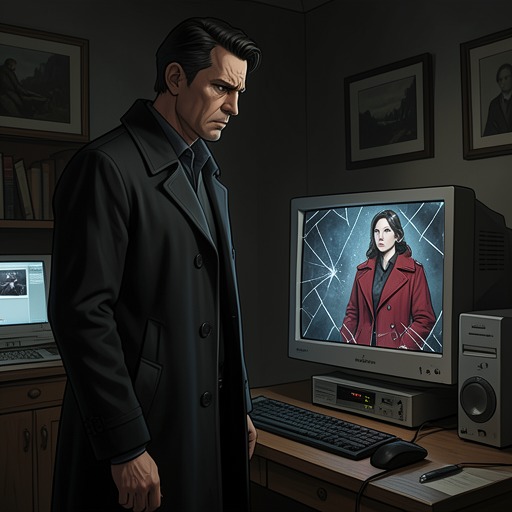
The clan's commercial nature becomes explicit when Kain presents Hengst with a file concerning a contract in the city. The contract has detected an opportunity involving a corporation that successfully kidnapped two freshling samurai. The corporation's holding facility failed to display a prearranged signal, causing its superiors to become nervous. They suspect that the samurai escaped and fear that the prisoners might locate them despite the prison's isolation.
Hengst responds not with concern about the kidnapped people but with appetite for the weakness exposed by the failed operation. The identity of the corporation is not yet known; the contract will provide the details after an advance is paid. Even incomplete information is enough to attract him, because uncertainty has created a vulnerable client and a potentially profitable intervention. The clan's violence is therefore entrepreneurial as well as ideological: it searches for breakdowns in other organizations and converts their fear into leverage.
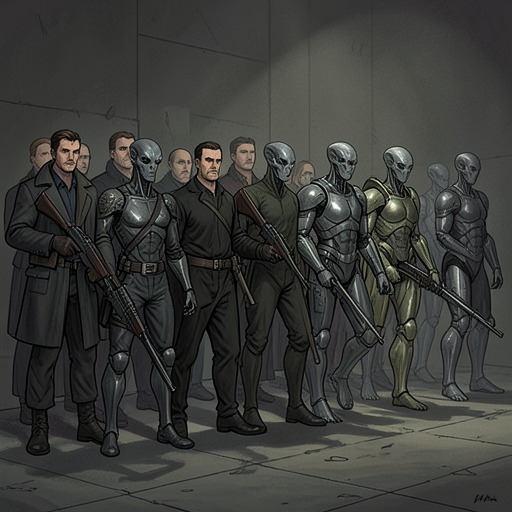
The two kidnapped samurai are connected to the wider conflict surrounding the Antithesis incursion. Elsewhere, Antithesis forces emerge in vast numbers from black-plated model Three organisms and reproduce through greenish pink fruit-blisters that flower into further model Threes and model Ones. During the global incursion, maps show hordes attacking population centers across North America, while military bases attempt to funnel the tides into cordons. Söldnerklan Feuerschwarz exists within this militarized world but is not presented as a public defender. It is a private force positioned to profit from the disorder produced by invasion, corporate overreach, and the proliferation of samurai technology.
Narrative and Political Significance
Söldnerklan Feuerschwarz provides one of the book's starkest portraits of privatized military power. It stands apart from community defense in New Montreal, where walls are being raised and residents attempt to keep children safe, and from samurai who confront Antithesis hordes directly. The clan instead joins the ecosystem of corporations, contracts, and clandestine facilities that treat advanced bodies and weapons as assets to be acquired, contained, or recovered.
Its underground headquarters literalizes the moral architecture of the organization. Aboveground cities endure invasion, sirens, crushed vehicles, blocked shelters, and mass casualties; belowground, the clan preserves secrecy, trains children through abuse, and conducts business over the capture of samurai. The contrast exposes a second violence beneath the visible war. Antithesis attacks are spectacular and immediate, but Söldnerklan Feuerschwarz's system is intimate and institutional: it reproduces cruelty in corridors, training halls, files, contracts, and small acts of humiliation.
The clan's role is consequently both military and social. It produces personnel, disciplines bodies, conceals victims, and exploits the failures of better-funded organizations. Hengst Rheinschiffer's confidence that he has made no fatal mistakes is part of the danger. The organization has survived because its leader understands fear as administration, pain as training, and instability as opportunity. Its most consequential weapon is therefore not a particular firearm or battlefield formation, but the closed system that turns vulnerable children and collapsing institutions into extensions of his power.